Platform

Six modules, one association record

Everything a self-managed board keeps in four different places, kept in one. Written for co-op, condominium and homeowners’ association boards that do the work themselves.

Property Concierge

It names the document, or it says it does not know

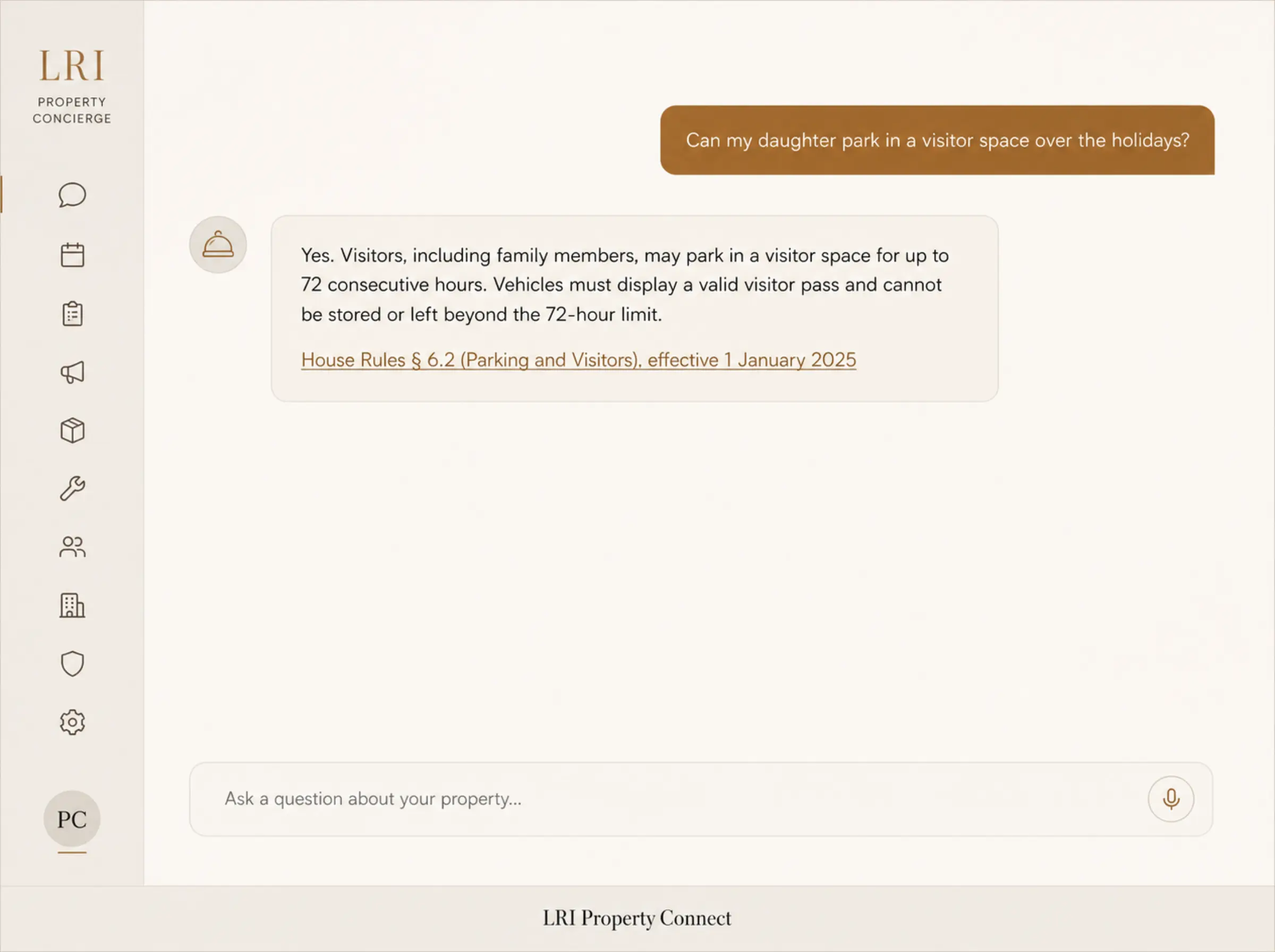
Ask what the house rules say about a dog, a contractor, a sublet. The answer quotes the rule, names the document, and gives the date it was last revised. It only ever reads from documents the board has approved.

  • Approved property sources, each with an owner, a version, an audience and a review date
  • Every supported answer names the paragraph it came from
  • English, Spanish, French and Italian
  • Opens a service request, finds a contact, points at the right page in the portal
  • Hands the question to a person when the record does not settle it
  • When a rule is amended, the superseded version stops answering
How the concierge is governed
A property concierge conversation: a question about the house rules, answered with the rule, the document it came from, and the date it was last revised
Illustrative. The shape is real; the building is not.
Board governance

A year later, you can still answer why

The packet the board read, the motion as it was worded, the roll of who voted which way, and the assignment that came out of it, kept attached to one another. Approving minutes becomes a review rather than a reconstruction six weeks later.

  • A meeting calendar, an agenda builder, and minutes that assemble as the meeting runs
  • Board voting on motions, with recusal tracking and automatic resolution numbering
  • Obligations that close only when the document proving them exists
  • What is open, and how long it has been open
  • A board workroom that does not leave three directors off the thread
  • A guided setup for whoever inherits the administrator seat next year
See one decision, as the record holds it
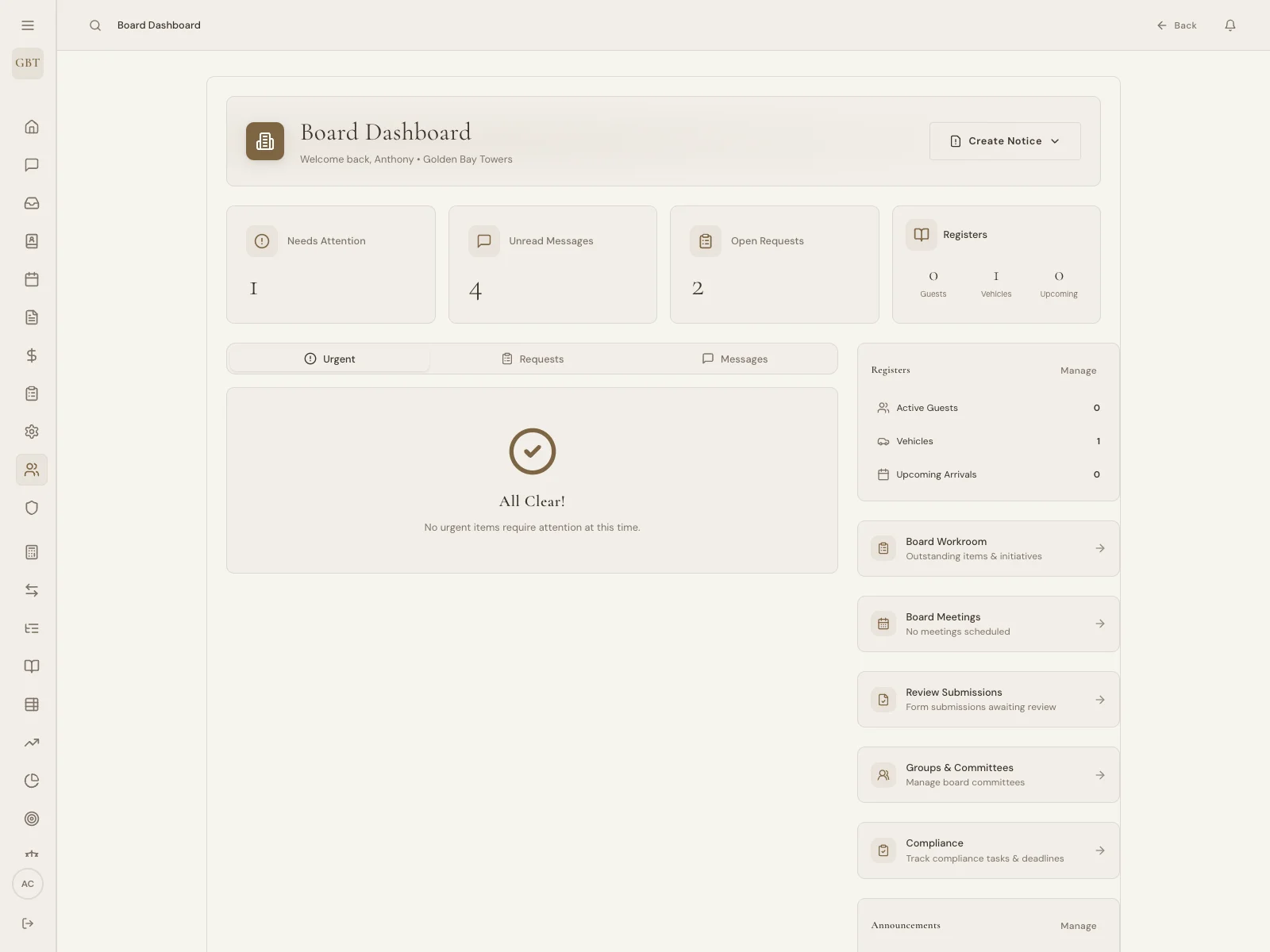
A board governance view: the meeting calendar, the packet attached to a motion, and the roll of who voted which way
The other four

Records, residents, the public site, and the reminders

Documents

A document does not speak until someone approves it

Uploading a document does not make it answerable: a document becomes a source for Property Concierge only once the property approves it for that use. PDFs, Word files, spreadsheets and rich HTML are all supported, with version history and audience controls on each.

  • Text extraction and search across the library
  • Separate controls for who can see a document and whether it may be quoted
  • Version history, with the person who approved each one
  • Resident-facing and board-only sit in the same library, not two systems
Resident portal

Where the resident actually opens it

Announcements, the directory, a service request that shows who picked it up, and a marketplace for the building. Restrained, legible, and quick on a phone, which is where residents actually open it.

  • Announcements the board writes once and everyone reads in the same words
  • A directory each resident controls their own entry in
  • A marketplace for the building: furniture, parking spaces, the kayak nobody uses
  • Guest registration, and a new resident walked through the building’s rules on the day they get their keys
A public site, through Park & Palm Studio

A public site that reads from the same record

A designed public site for the property, on its own domain, drawing live from the record the board works in — so the amenity list on the public page is the amenity list in the building. Built as a separate engagement through Park & Palm Studio.

  • Your own domain. goldenbaytowers.com is the live one.
  • Residence listings with detail sheets and inquiry forms
  • Server-rendered, so a buyer’s search actually finds it
  • Designed for the one property, with motion that respects reduced-motion settings
Notifications

The reminder arrives before the certificate expires

Renewals, deadlines, requests, approvals and votes each notify the person who has to act on them, before the date, and again after it if nothing happened. Nobody carries the calendar in their head.

  • Notifications on renewals, deadlines, requests, approvals and votes
  • In the portal and by email, so the one that matters is not only in the portal
  • The treasurer hears about the reserve transfer; the resident does not
  • Mark read one at a time or all at once, because nobody reads forty of them
Provenance

The order this happened in

Software companies usually find a market and then learn the domain. This went the other way, and you can check the sequence yourself.

1962

A cooperative opens on the Intracoastal

Golden Bay Towers — twin six-story towers, 89 units, private boat docks, architect Harold Wiecer. Sixty years later it is still self-managed: a volunteer board, no management company.

Then

A board member becomes its president

Anthony Clemenza, who founded this company, presides over that board today, and is a New York attorney. He inherited what most self-managed boards inherit — a filing cabinet, a shared inbox, and a spreadsheet only one person understands.

768 pages

He writes down how the statute says it should work

The Florida Co-Op Board Handbook: 29 chapters and 203 companion forms on what Chapter 719 requires of a cooperative board, published by Park & Palm Press.

Now

Then builds the software that does it

Park & Palm Connect runs the association the handbook describes. The building, the book, and the platform are the same story.

Tell us about your building

Forty-five minutes with a principal. Bring your unit count, your operating budget, and what you pay for bookkeeping today.